

https://unfccc.int/news/un-climate-chief-major-keynote-thanks-to-global-...
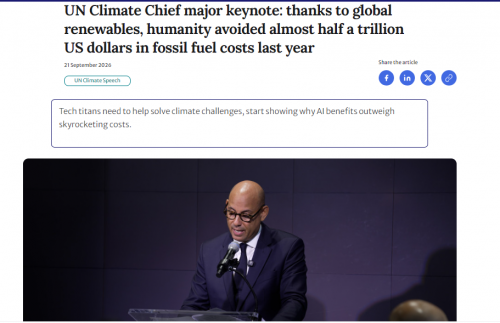
The following is a transcript of a speech delivered by UN Climate Change Executive Secretary Simon Stiell at the Build Clean Now Industry Acceleration Summit on Monday 21 September 2026 in New York City.
Good morning.
It’s a pleasure to join you today.
And I thank the ITA for hosting us.
The new King of New York – Knicks basketball star, Jalen Brunson said: "You’re allowed to think about the worst possible scenario. But you’ve got to go out there and do something about it."
He’s right.
Holding the rise in global temperature to 1.5 degrees Celsius this century is demanded by science, agreed by nations, and essential to protect every person and economy.
Yet exceeding that limit is now guaranteed, at least temporarily. A recent report by the UN Environment Programme reaffirms it.
How to respond?
By doing something about it: Building resilience. And cutting greenhouse gas pollution faster – to bring the temperature rise back below 1.5 degrees as quickly as possible.
That demands international cooperation, laser-focussed on implementation, supporting delivery of the targets, plans and commitments countries have agreed.
Our systems have proven they can drive real change.
UN-convened cooperation – and national efforts – have reduced the projected global temperature rise – from well over 4 degrees Celsius, to 2.6 degrees Celsius – undeniable progress but not enough to avoid catastrophe.
And the Paris Agreement – and other COPs – have helped unleash an energy revolution – even if it’s still globally uneven, and vulnerable countries need support to get fully on board.
Take new data released today by the International Renewable Energy Agency: last year, renewable capacity additions reached a record high: 693GW. That’s over half the installed power capacity of the entire United States.
And thanks to global renewables, humanity avoided almost half a trillion US dollars in fossil fuel costs. Almost half a trillion – that’s a mammoth decarbonisation dividend – that’s more than the national GDP of over three quarters of countries on Earth.
And clean energy’s attracting extraordinary investment: over USD 2 trillion last year alone. While driving jobs and growth the world over.
Friends,
Pointing to progress is not about complacency. It is essential. To combat disinformation and show that this is a fight we can win.
This is the moment to mobilise more. To narrow the gap between pledges and action on the ground.
That will be a central focus of COP31 in Türkiye, and COP32, in Ethiopia next year.
By the second global stocktake in 2028, we must show substantial progress against commitments made in the first. And, from there, identify what’s needed to close the gaps – on both implementation and ambition.
At UN Climate Change, we’re committed to finding ways to help the international process to deliver more. For example, we’re looking at whether countries could designate a representative to coordinate across governments and the private sector – to drive the transition in every industry.
And we are exploring operational opportunities to provide spaces to enhance action. For example, an Action Agenda closing plenary at COPs, alongside the negotiation closing plenaries.
The Action Agenda is a vital part of the work ahead. It's where business, investors, governments, cities and regions, and many more, come together to deliver real economy actions.
In other words, it’s the fast lane to more implementation. Key to helping countries to put their national climate plans into practice.
And there is value in strengthening it within the international process, to complement negotiations, which will remain front and centre.
Getting almost 200 countries to agree on every word is incredibly hard but incredibly important.
No single COP can fix this global crisis, but each takes meaningful steps forward.
COP31 negotiations can support accelerated implementation: enabling stronger institutions and faster technology transfer, improving flow and access to higher-quality finance, and helping countries with their own just transitions.
The Action Agenda can also drive much needed real-world progress.
The Turkish COP31 Presidency – working closely with Australia – has set clear Action Agenda targets, including for electricity to reach 35% of global energy use by 2035.
I urge countries, business leaders, investors and more to respond to the Presidency’s call. And to come to Antalya with solutions that help drive implementation at greater speed and greater scale.
That includes delivering real results to get projects off the ground in developing countries. The UN carbon market is up and running, providing potential new channels for investment.
And our focus this year is meeting existing finance commitments, boosting quality and access. Mobilising every part of the system: from public and private finance, to climate funds, Multilateral Development Banks, and more.
Together, they can get capital flowing, and move the Baku to Belém Roadmap to USD 1.3 trillion closer to reality.
This is no time to backtrack.
This is the time for all shareholders who believe in science, facts, and saving millions of lives to stand firm and step-up on climate.
Friends,
COP31 will be a big tent. Anyone with real solutions is welcome.
The ITA shows that this is what it takes to drive progress.
And your efforts are moving clean industry closer to reality, at scale.
19 commercial-scale projects reached final investment decisions in the first half of this year alone. Together, worth an estimated USD 43 billion.
You are tackling hard problems head on. Which is what this moment demands.
The UNEP Overshoot report is clear.
Bringing global temperature rise back down to 1.5 Celsius will require much greater cuts to planet-heating fossil fuel pollution.
We’ll also need carbon dioxide removals, or CDR – as the IPCC has long assumed – absolutely not as a replacement for transitioning away from all fossil fuels. But in addition to it.
Protecting and enhancing natural carbon sinks will be vital.
Despite some isolated initial efforts, the world is nowhere near ready to deliver, partly due to fears that talk of CDR hands polluters a free pass to continue business as usual.
Many of those fears may well be valid. But simply ignoring CDR is no longer viable.
More policy leaders, investors and innovators need to start tackling this issue – while recognising that transitioning away from fossil fuels can never be circumvented.
Cutting emissions – like building resilience – will always be essential.
Tech titans are increasingly central to that fight.
If AI can solve a 90-year-old math problem in days, it can do more on key climate challenges: building on existing efforts, in areas such as improving early warning systems for climate disasters. And accelerating grid efficiency.
We need every country to benefit from AI today – not vague promises of future solutions.
That means addressing the barriers faced by developing countries. And creating accessible, efficient solutions.
In the world's climate fight, there’s already a worrying two-speed global transition. AI must help bridge, not inflame, this divide.
We also need the industry to respect science and start aligning with global climate efforts – urgently.
Energy guzzling Artificial Intelligence is driving up planet-heating pollution from coal, oil and gas, while ratcheting up energy costs for households and businesses. All while fuelling disinformation, social division, and even larger inequalities of wealth.
AI leaders are now on thin ice when it comes to license to operate, and sinking deep underwater when it comes to public support.
In this country, from the Empire State, to the Lone Star State, datacentres are being put on hold. It’s a similar story in many other parts of the world.
Industry leaders need to step up, including CEOs and boards.
Tech titans need to start showing why the benefits of AI outweigh its skyrocketing costs – for the many, not just the tiny few.
By setting and delivering credible climate targets if they haven’t already.
Investing in efficiency, building on existing gains.
Coming clean about their energy and water use, and powering data-centres with renewable energy – as the UN Secretary-General has said.
Friends,
In almost all places, we're seeing an historic disconnect: between the spiralling scale of the climate crisis impacting billions of daily lives, and the calibre of the response.
This makes no sense, morally, economically or politically.
From the tragedy of the Himalayas. To brutal, economy-slowing heatwaves. And the supercharged impacts of El Niño, set to get worse. The climate crisis is now a national economic and security emergency for all nations.
It should be top of every government's agenda.
Lives and livelihoods are being wrecked. Health impacts and costs are soaring, and health systems are coming under huge strain.
Climate-disasters are hitting crop yields, driving up food prices and wider inflation.
Billions of people around the world are realising that fossil fuel dependence is hitting them hard at the fuel pump each week.
It’s been estimated that since this Middle East conflict began, fossil fuel dependence has heaped over USD 100 billion in extra costs on US consumers alone, just in higher gas and diesel prices.
Any leader serious about combatting inflation, building strong economies, and protecting their citizens, must be serious about cutting the planet-baking fossil fuels driving this climate crisis, and about building resilience.
It's clear now that countries that choose to resist the clean transition aren't protecting old industries – they're sending new innovations, sectors, jobs and pay checks to competitor economies.
Renewables are now cheaper in almost all places. The brute power of market forces is taking hold.
Last year renewables overtook coal as the world's top electricity source.
The shift to clean energy is now irreversible – as all countries at COP30 said in unison.
So friends,
For these reasons and more, we are still absolutely in this fight.
But to win will take far more.
Now's the time to double down on climate multilateralism – the bedrock of the world's progress so far.
At COP30 every nation agreed – the Paris Agreement is working, and we will make it go further and faster.
Let's get to work.
Thank you.