

https://www.sportanddev.org/latest/news/building-multilingual-sportandde...
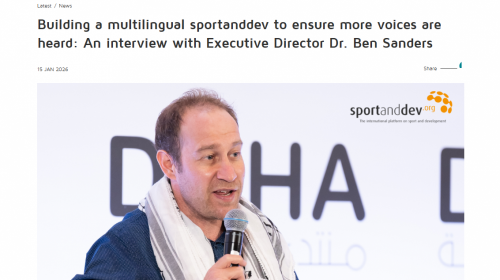
In the second part of the interview, Dr. Ben Sanders, Executive Director of sportanddev, discusses the platform’s efforts to amplify diverse voices in the sport for development and peace (SDP) sector. He explains why becoming multilingual was a major step for accessibility and inclusion, and highlights the crucial role of the Steering Board in guiding strategic decisions and uniting influential organisations worldwide.
In conversation with Dr. Ben Sanders, Executive Director of sportanddev
Q: In 2025, the phrase 'More voices are heard' became central to sportanddev’s mission. Why was taking the major step to become multilingual so important for the platform?
It’s a good question. sportanddev was founded in 2003 and has mirrored the growth of the sport for development and peace (SDP) sector. While SDP has grown rapidly in the past 20 years, it is still very unequal with many challenges and opportunities. Organisations in high-income regions have more resources and more influence on policy. The intersecting crises I spoke about earlier have worsened this inequality, with actors in more under-resourced regions at risk, while recent gains made may be lost.
One reason for this inequality is that information, tools and resources are often siloed, inaccessible, and exclusive, and not available in other languages or formats. People who can speak or understand English can access more learning resources, events and opportunities. Those who can’t are disadvantaged. They have fewer options to improve their skills and ultimately less influence on global policy and decisions.
Regions such as the Middle East, West Africa, and Latin America (among others) are hugely important but often under-represented in SDP policy and decision making. We launched our website and MOOC in these languages to tackle such challenges and respond to the needs of our diverse global community.
We received feedback from many of our community members that resources and tools, even official UN and government reports and policies, simply didn’t exist in their languages. So first, we launched the sportanddev website in French in 2015, then Arabic in December 2023 and Spanish in February 2024.
One reason for this inequality is that information, tools and resources are often siloed, inaccessible, and exclusive, and not available in other languages or formats
Why English, French, Arabic and Spanish?
While Mandarin Chinese has the highest number of first-language speakers, according to Berlitz English has the most when considering both native and non-native speakers (1.452 billion). Spanish is the fourth most widely spoken language overall, with more first-language speakers than English.
French and Arabic come in at fifth and sixth respectively. All four languages are spoken in multiple countries and also commonly learnt by non-native speakers. They are also spoken in regions of the world where many organisations implement SDP policies and programmes.
There are many languages in the world – more than 7,000, according to Ethnologue. However, we felt these four languages were a good place to start. They are also four of the six United Nations official languages, with Russian and Chinese the other two which we may attempt to work in, in the future.
We have also launched our Massive Open Online Course (MOOC) on Sport for Sustainable Development: Designing Effective Policies and Programmes in these same four languages. The course is developed and managed by the Commonwealth, Australian government and sportanddev, with support from key partners.
Join 10,000+ others in our Massive Open Online Course for free
- Sign up for our English course
- Inscrivez-vous à notre cours de français
- Regístrate en nuestro curso de español
- شترك في دورة اللغة العربية لدينا
Q:The Steering Board guides sportanddev’s high-level strategic decisions and has been key in driving the platform's vision and long-term commitment. Why is this role so important, and what is the secret to uniting these diverse and influential organisations?
The sportanddev Steering Board is hugely important to sportanddev. And it always has been since it was formed in 2007. Steering Board members contribute financially and in-kind to sportanddev, investing in our overall vision, mission and goals. They also provide oversight of sportanddev and the Operating Team which I lead. And they contribute greatly with expert insights within SDP, the broader sport sector and the broader humanitarian and development sector (like the UN Refugee Agency for example).
I am also pleased to say that we have diversified the Steering Board over the last few years. It was mostly composed of European-centric organisations. Now we have members from all over the world, including non-profit foundations headquartered in sub-Saharan Africa and Latin America. The board also includes intergovernmental agencies who can work at scale like UNHCR, the Commonwealth and national governments such as Australia working regionally to support and strengthen SDP in the Pacific.
Stay tuned for the third and final part of this interview, And in case you have any questions for Dr. Sanders, feel free to leave them in the comment box below. Image credit: DOHA Forum