

https://www.sportanddev.org/latest/news/leading-sportanddev-through-glob...
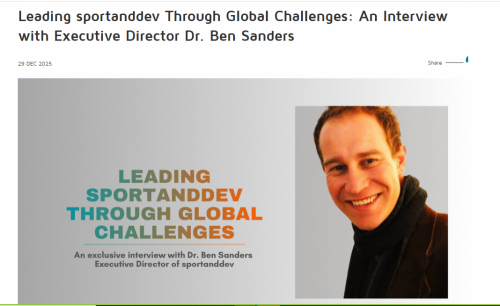
In the first part of this interview series, we shine a spotlight on sportanddev’s mission, reflect on key achievements from 2025, and examine the sector’s progress towards the Sustainable Development Goals (SDGs). We also explore sportanddev’s response to recent global crises and share key takeaways from a challenging year.
In Conversation with Dr. Ben Sanders, Executive Director of sportanddev
Q: Looking back on 2025, how do you assess sportanddev’s role in advancing its mission amid
growing global challenges — and how close are we to realising that mission today?
2025 has been a challenging and rewarding year for sportanddev. And for many others working in sport and development.
The world faces a range of increasingly complex and interconnected challenges. These include escalating
humanitarian conflicts, cost-of-living crises, and increasing inequities. Equally urgent is the environmental apocalypse, deep-seated health issues, growing polarisation, challenges to aid and development assistance (which I elaborate more on below) and economic headwinds. There are also unequal power relations between and within the Global North and South. And much more.
Further, only 18% of the Sustainable Development Goals (SDGs) targets are on track to be met by 2030. The remaining 82% of targets show limited progress - worryingly 18% of targets have gotten worse, 17% have stagnated and 31% show only marginal progress. There is a larger gap between the average SDG performance of the poorest countries and the global average than in 2015. It is not looking good.
Sport reflects, and contributes to, many of these challenges but can help tackle them – if used in certain ways. Given this scenario, it is more critical than ever for sport to better serve society. This is what fuels our mission at sportanddev.
Firstly, we need to make sure that gains are not reversed and that the use of sport for development and peace (SDP) is SUSTAINED. That is necessary but not sufficient.
Secondly, we always need to critique our work and get better so that we can STRENGTHEN sport’s role in development.
And finally, we need this to be REALISED at scale. We know that some SDP projects work in some places sometimes. We need cost-effective and proven approaches that can contribute to development outcomes, like health, education, crime prevention, environmental sustainability and so on, at scale.
In some ways, our mission will never be complete – as the world continues to grapple with so many longstanding and complicated problems. And sport can always do better, I think. I mean better for society. Not for sport. We need to be less serious about ‘serious (elite) sport’ and more serious about sport for all, sport for development, community sport, grassroots sport. This is where sport’s greatest value lies. It is time for a new sporting dream. A new sporting pyramid. A sporting manifesto for all.
At sportanddev, we work with a range of partners to address these challenges and maximise sport’s contribution to sustainable development. This has driven our Reshaping Sport and Development campaign and our work to offer resources (including our website and MOOC) in multiple languages.
There is still a long way to go, and always room to improve. We invite you to join us on this journey.
Q: The SDP sector has suffered major challenges in 2025, particularly following major global funding cuts from USAID and other donors. While the sector has faced other setbacks before, what have these recent crises taught you personally and what advice would you offer to organisations navigating this moment?
Yes, the recent and rapid cuts to global aid and the ripple effects are devastating. They have serious consequences for development, diplomacy and peace outcomes across the world, including sport for development and peace (SDP).
While we have faced a range of challenges in recent times such as the COVID pandemic and the closure of the UNOSDP, I would argue that the global aid crisis is more profound and harder to overcome. This is because once aid is dismantled, like has happened with USAID, it is incredibly difficult to replace and/or revive. The USA supplied over 40% of all humanitarian aid tracked by the UN or about 29% of total aid from OECD DAC countries. This cannot simply be replaced no matter who steps in. And actually, most other developed nations (e.g. those in Europe) are also increasing military spending and decreasing aid.
This presents real risks for SDP actors and all those using sport for development goals. Partners of ours such as UNHCR have cut thousands of jobs and reduced their sport for protection portfolio. Sportanddev had a long-term partnership with USAID to mainstream SDP within the agency which could have contributed significantly to the growth of SDP worldwide and of course was an important grant for us. Like around 10,000+ other grants it was terminated. Lives and livelihoods are being lost right now.
Some examples which illustrate this include:
- The loss of support to Global Vaccine Alliance (GAVI) is projected to deny 75 million children routine vaccinations in the next five years, likely resulting in over 1.2 million child fatalities.
- The World Food Programme warns 58-million people are at risk of extreme hunger or starvation due to funding cuts.
- A study warns that the virtual dissolution of USAID and the reduction in international aid from other donors could result in up to 14 million additional deaths by 2030.
All preventable.
I am not trying to be negative, just realistic. There may be some silver linings but overall, the effect is devastating. And we should recognise and fight to overcome it – and not just bury our heads in the sand and move on. And yes, there may be some silver linings, but these are a drop in the ocean unfortunately.
As Filippo Grandi, the UN High Commissioner for Refugees said in an excellent piece co-authored with ISCA:
I don’t want to hear any more people telling me to ‘do more with less.’ This is absurd. You will do less, with less. We will try to do it in the best possible way, the most rational way, maximising efficiencies – becoming even more efficient. But it’s going to have an impact on millions of people – who will receive less food, less cash, less water and will benefit less from a protecting presence, as UNHCR has in many places.
What is sportanddev’s stance?
At sportanddev we are gravely concerned about the current crisis. We call for continued funding and support for sport to contribute to development and peace, especially in the Global South.
We call for SDP actors to stand together and show unity at this tumultuous time.
We stand firm against the backlash towards diversity, equity and inclusion.
We believe that the current crisis presents challenges and opportunities.
It provides an opening to write a new narrative for the SDP sector.
But make no mistake. Opportunities exist but there can be no denying the scale of this crisis
Q: You often draw on Nelson Mandela’s words in your public work. Which of his quotes do you feel best reflects the state of sport and development today, and how has the field changed since his time?
Well, Nelson Mandela is quite a legend and as I am proudly South African, his words often resonate.
Having said this, I actually don’t use his power of sport quote much. I think that this has been overused. And while I agree that sport CAN make a difference, and indeed this is my life’s work and mission, it needs to be used in a certain way. As I argued once in a podcast, we should be cautious of evangelizing sport. Sport is not magic. It is not inherently or automatically positive (or negative). It is HOW sport is used which makes the difference. A sport project can reinforce gender stereotypes, or it can challenge them, it can tackle violence, or it can catalyse violence. We must always remember that it is complex.
Secondly, people outside sport will not take sport and SDP seriously if we keep evangelizing about sport without ignoring the fact that it can do or enable harm. That some sports bodies are corrupt, badly governed and act with impunity. That human rights abuses can take place in sport. In fact, we need to spend less time convincing ourselves and others in SDP and sport that the use of sport can be beneficial. We need to be talking with people outside sport – after all the whole point of sport for development is, to achieve goals that are not sports goals (e.g. excellence) but societal goals (e.g. health). We need to be balanced and explain that sport can contribute to development outcomes if used in certain ways.
So, back to Nelson Mandela, I already used a quote from him above about speaking other languages. Another favourite of mine is this quote on combining vision with action.
Action without vision is only passing time, vision without action is merely daydreaming, but vision with action can Change the World.
We see so many great policies and plans, but poor implementation and follow through. The gap between policy and practice and between research and reality is too great. We try to bridge this gap at sportanddev in many ways, from synthesising research (see our Quarter 2 Research Wrap for example), developing a resource library, producing toolkits and learning resources, like our MOOC. And more. And most importantly, raising funds so that we can keep all the above free and without fear or favour.
Another quote of his I often use comes from the end of his autobiography Long Walk to Freedom, where he says: “I have discovered the secret that after climbing a great hill there are many more hills left to climb.” I think this speaks to sport and development – we have done well but we have so much further to go.
Part Two of this interview, to be published in January 2026, will focus on how sportanddev is responding to the challenges discussed above through greater inclusion, multilingual access, and long-term strategic leadership.