

https://crawford.anu.edu.au/event/tap-water-access-paid-work-time-eviden...
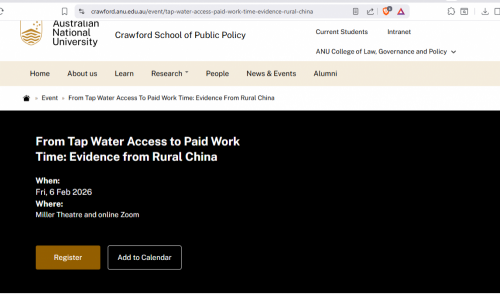
Yiyi Zhao presents her research on how access to tap water affects paid working hours in rural China.
This study examines the effects of household tap water access on paid working hours in rural China. Using longitudinal data from the China Family Panel Studies (CFPS) spanning 2014 to 2022, the analysis employs a fixed-effects instrumental variable (FE-IV) approach to estimate the impact of access to tap water on weekly paid working hours.
To address endogeneity, I use an interaction-type instrument that links village-level tap water access rates (excluding the household itself) with province-level drainage infrastructure density, measured as the national average excluding the household’s own province, to capture plausibly exogenous variation in local exposure to water infrastructure expansion.
To further strengthen inference, a dynamic framework is employed to examine how the effects of tap water access unfold and stabilise over time, leveraging the phased rollout of China’s National Rural Drinking Water Safety Project during the 13th Five-Year Plan period (2016–2020).
The results indicate that access to tap water significantly increases paid working hours among employed rural residents, with estimated effects ranging from 1.0 to 3.6 additional hours per week, depending on model specification. The primary mechanism underlying this effect appears to be a reduction in time devoted to domestic housework, estimated at approximately 17.6 fewer minutes per day.
This reallocation of time facilitates greater labour supply and is accompanied by modest increases in midday rest periods (4.9 minutes per instance). Subgroup analyses reveal that the labour supply response is particularly pronounced among agricultural workers, self-employed workers and individuals without young children in the household. The estimated effects are statistically significant and of similar magnitude for both male and female respondents.
Event Speakers