


https://www.ids.ac.uk/opinions/ids-alum-is-on-7000-km-tour-of-maharashtr...
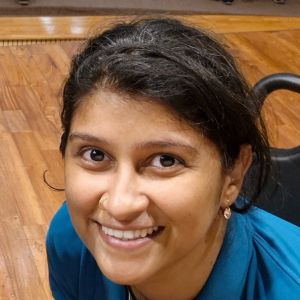
Diksha Dinde, MA Governance, Development & Public Policy, Class of 2022-23, talks about a transformative conversation at IDS that shifted her perception about accessibility. She is currently embarking on a 100 day journey to initiate conversations about disability and inclusion.
On the International Day of Persons with Disabilities, I write this from the middle of the road—literally. Today is the 48th day of the Inclusion Yatra, and we (my partner and I) are on our way to Georai to speak with children from a marginalised community.
The Inclusion Yatra, which began on 8 September, is a 100-plus-day journey across every district of Maharashtra to initiate conversations about disability, inclusion and accessibility at the grassroots level. This journey is not just travel; it is a moving classroom, a mirror, and sometimes a quiet revolution.
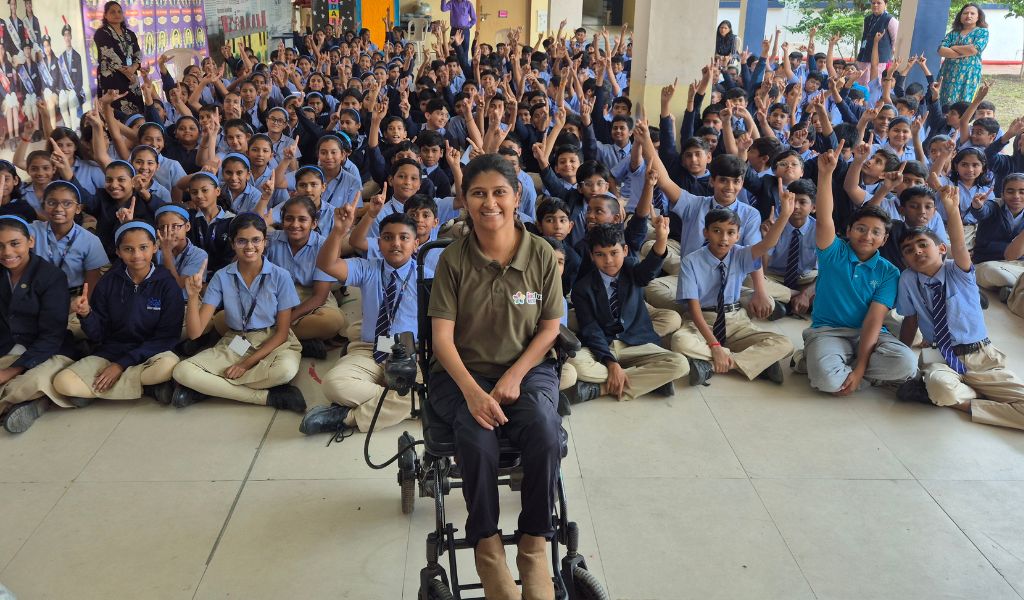
In this first phase alone, across 48 days, we have reached more than 12,000 people. But these are not just numbers. Each day carries at least one real shift, one conversation that led to visible change: a classroom shifted from the second floor to the ground to make space for a child with disabilities an architect who rethought his “perfect” design and promised to revisit it, a parent who said she now wished for her child to freely move around on an electric wheelchair, a government official who acknowledged that his inaccessible office would make it impossible for a person with disabilities to come and seek justice, and promised change. What began as a personal calling has slowly transformed into a collective movement.
I am not disabled by my body; but by the barriers around me
My perspective on disability took a defining turn when I pursued my master’s at IDS. Until then, despite working for eight years in the disability space, my approach was mostly welfare-driven. The UK helped me make a deep internal shift towards a rights-based approach.
I vividly remember my first day at IDS, when Colin Anderson, one of the faculty members of MA Governance, Development & Public Policy, said to me, “We may not be fully equipped to meet your accessibility needs, (I am a wheelchair user) but that is my problem, not yours. You just focus on your studies.” Those words moved me to the core. Until that moment, I had internalised the idea that I was the misfit, the problem, and that accessibility is a privilege, not a right. IDS gave me the language to undo that conditioning. It helped me realise that I am not disabled by my body; but by the barriers around me.
Throughout my life, I have had to adjust to my surroundings. Reasonable accommodations were rarely offered. My classroom was on the second floor and I had to rely on my mum to carry me. I have been denied access to education, healthcare, employment, prevented from freely moving around my environment and excluded because of structural neglect. My time in the UK was the first time I lived my life without any barriers and with dignity. When I returned to India, I could no longer accept living as a secondary citizen in my own country. I knew that what I had experienced abroad should not remain a distant dream, it should become reality here too.
It was during a conversation at the airport in January 2024 while returning from the UK that the idea of sensitising people around disability began to form between my partner, Amol, and me. At that time, it was just a vague idea without structure or roadmap. Life happened, work consumed us, but something inside remained restless. Eventually, through conversations with friends and mentors, the idea of the Yatra gained shape. I thought about how I had grown up with access comparatively speaking in a city like Pune, where finding support is easier. But what about those people with disabilities living in remote or tribal areas? What challenges do they face? Who listens to their stories? What systems exist around them? If I wanted to work in public policy in the future, how could I do it honestly without listening to those who are most affected? That question became the heart of the journey.
Explaining disability through action
That idea—one that was born during a conversation at an airport in the UK – helped us to start Equibridge Foundation. Work started with sensitisation sessions, accessibility consulting and educational counselling. Over time, the Yatra transformed from a concept to a lived experience—a 100 plus day journey across all districts of Maharashtra, where disability is not explained through presentations, but through connection, action and lived experience.
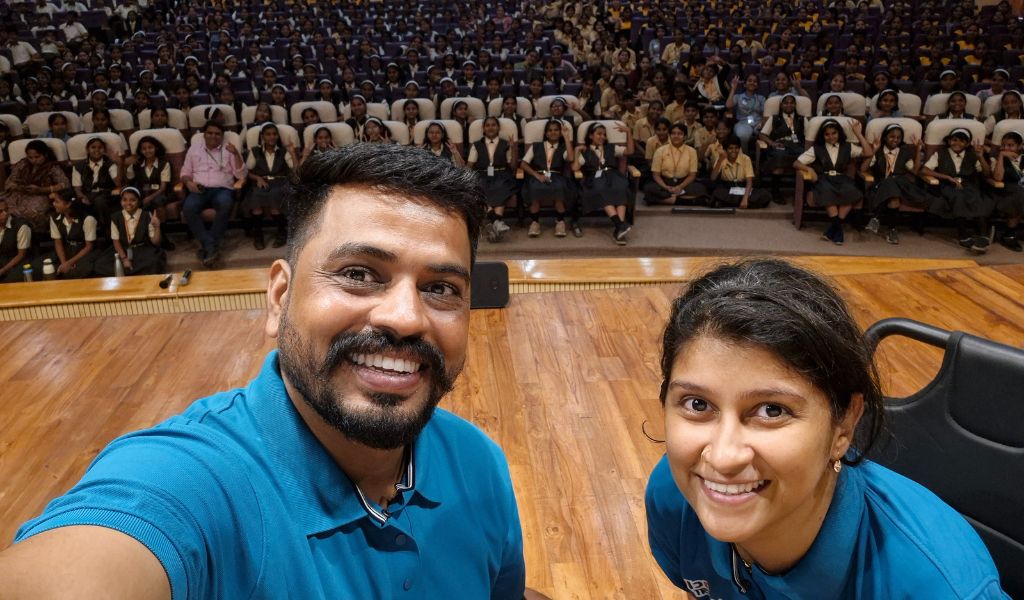
Through the Inclusion Yatra, we conduct facilitation-based sessions using a mix of conversations, storytelling and interactive activities. We work with students, teachers, educators, parents and officials across rural, tribal and urban regions. What we witness is gradual but clear: a shift from sympathy to understanding, from charity to rights, from hesitation to collaboration. Teachers correct their language. Parents ask how to support without pity. Students begin advocating for classmates. These are not extraordinary changes; they are practical and deeply human. They are the foundation of inclusion. It is a continuous effort to shift mindsets at every level—from a child in a classroom to a policymaker in a government building. Nearly every day, at least one person told us they will carry the message forward. Slowly, the journey is no longer just mine; it is becoming something people feel responsible for.
Not all days are rewarding. Some days are met with indifference, disinterest or last-minute cancellations. Or a broken down car. These days remind me that this journey is not about validation; it is about perseverance.
An epic journey
As of today, we have covered 12 districts of Maharashtra and will continue until February. In the next phase, we hope to deepen this movement by building a network of local inclusion champions, strengthening capacity through training rooted in lived experience, and feeding our field learnings into education and governance systems. Every conversation strengthens this movement, until decision-makers have no choice but to recognise accessibility as a fundamental requirement.
My hope is that when this Yatra completes its final kilometre, the movement will not end. I want to see these conversations take root like seeds that become forests, growing quietly in homes, classrooms, offices and community spaces. Support for this work is not only financial or logistical. The real support lies in people examining their own behaviours and systems, not as charity but as a commitment to equity.
There was a time in my life when I felt “I do not want to live anymore.” During this Yatra, especially in moments of uncertainty and physical exhaustion, I have often caught myself thinking, “I do not want to die yet.” That shift by itself tells me something inside has healed. This journey started with a sentence at IDS that told me the barriers were not mine to carry. Today, that sentence is carried by hundreds of people across Maharashtra, each holding a piece of this movement.
On this International Day of Persons with Disabilities, I acknowledge that inclusion is possible, it is practical and it is already emerging through quiet but powerful actions.