

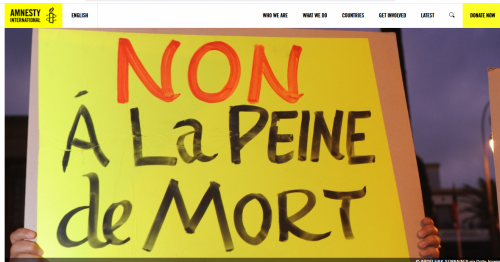
Responding to an announcement on 04 December that Burkina Faso’s government has decided to reintroduce the death penalty seven years after it was abolished for ordinary crimes as part of a reform of the Penal Code, Marceau Sivieude, Amnesty International’s Regional Director for West and Central Africa said:
“The death penalty is the ultimate cruel, inhuman and degrading punishment, and an irreversible denial of the right to life.
“This punishment has no unique deterrent effect, it disproportionately affects those from disadvantaged backgrounds and carries the danger of being used as a repressive tool to punish dissent.
Burkina Faso must immediately halt any plans to reinstate the death penalty regardless of the nature of the offences or crimes committed.
Marceau Sivieude, Amnesty International’s Regional Director for West and Central Africa
“The Transitional National Council must oppose the reintroduction of death penalty in the Penal Code, which would set Burkina Faso against the goal of abolition of the death penalty enshrined under various international and regional human rights treaties and instruments.
“Burkina Faso must immediately halt any plans to reinstate the death penalty regardless of the nature of the offences or crimes committed. Countries that still retain the death penalty are an isolated minority as the world continues to move away from this cruel punishment.”
Background
During a cabinet meeting on 04 December, the Burkinabe government adopted a draft bill to reform the Penal Code, which includes reinstating the death penalty for certain offences such as “high treason,” “terrorism,” and “acts of espionage”, as announced by the Burkinabe government’s information service. The bill must be approved by the Transitional Legislative Assembly.
The death penalty has been abolished in the Penal Code of Burkina Faso since 2018. The last recorded execution in the country was in 1988.
Trends recorded so far in 2025 indicate that executions have significantly increased in a handful of countries, with some governments showing renewed determination to use this cruel punishment as a tool of repression and control. The overwhelming majority of countries has rejected the death penalty in law or practice.
Amnesty International opposes the death penalty in all cases without exception – regardless of who is accused, the nature or circumstances of the crime, guilt or innocence or method of execution.